For anchor design in Shepparton, we use a trailer-mounted hydraulic drill rig capable of installing tendons up to 25 meters deep through the alluvial clays and silts typical of the Goulburn Valley floor. We carry both sacrificial and recoverable anchor types on site, selecting the appropriate corrosion protection based on the exposure classification. Before any tendon is tensioned, we verify the bond length through an initial pull-out test on a sacrificial anchor. The entire setup, from mobilization to load testing, follows the procedures outlined in AS 4678 for earth-retaining structures.
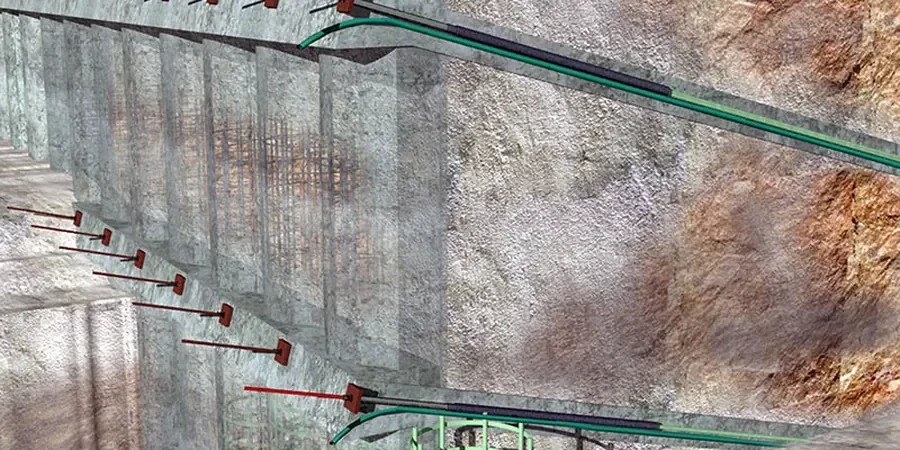
Active anchors apply a preload to the ground, while passive anchors only resist movement once displacement begins. Each serves a different structural need.
Method and coverage
Regional considerations
The alluvial clays underlying much of Shepparton are moderately plastic, with liquid limits typically ranging from 45% to 65%. When these clays wet up after installation, they can swell and reduce the effective stress on the anchor bond zone. This seasonal moisture variation, driven by the region's hot summers and irrigation cycles, is the primary risk for passive anchors that rely on post-displacement resistance. For active anchors, the risk shifts to long-term load relaxation. If the clay creeps under sustained preload, the anchor force can drop below the design lock-off value. To manage both risks, we extend the bond length into the underlying dense sand layer whenever possible and install a load cell on critical anchors for long-term monitoring. A field permeability test also helps predict how quickly groundwater fluctuations will reach the bond zone.
Standards that apply
AS 4678:2002 Earth-retaining structures, AS 1726:2017 Geotechnical site investigations, AS/NZS 1170.2:2021 Structural design actions – wind, FHWA-IF-99-015 Geotechnical engineering circular No. 4 (anchor design)
Other technical services
Permanent active anchor design
Pre-tensioned anchors locked off at 80% of working load for long-term retaining wall support. Includes double corrosion protection and proof testing on every anchor.
Temporary passive anchor design
Passive anchors installed for shoring and excavation bracing. Removable tendons are used when access to adjacent properties must be restored after construction.
Load testing and verification
Proof tests to 1.5 times working load on all production anchors. We also perform creep tests and cyclic load tests per AS 4678 to confirm long-term performance.
Anchor monitoring and re-stressing
Installation of vibrating wire load cells and hydraulic jacks for periodic re-stressing. This service is critical for active anchors in Shepparton's swelling clays.
This service complements our laboratory testing work for a complete project analysis.
Typical parameters
Top questions
What is the difference between active and passive anchors?
Active anchors are preloaded immediately after installation, compressing the ground and providing immediate resistance. Passive anchors are not preloaded; they resist movement only after the ground begins to displace. Active anchors suit permanent retaining walls, while passive anchors are commonly used for temporary excavation shoring.
How much does anchor design and testing cost in Shepparton?
The cost for a complete anchor design and testing package in Shepparton typically ranges from AU$1.460 to AU$6.000, depending on the number of anchors, the required corrosion protection class, and the soil conditions. This includes proof testing on each anchor.
Which soil conditions in Shepparton affect anchor bond length?
Shepparton's alluvial clays have moderate plasticity and can lose bond capacity when saturated. The underlying dense sand layer provides much better friction. We design bond lengths to extend into the sand whenever possible, typically requiring 6 to 15 meters of bond zone depending on the clays thickness and the required working load.
What corrosion protection is required for permanent anchors?
Permanent anchors in Shepparton typically require Class I or Class II corrosion protection as defined by AS 4678. Class I uses a greased and sheathed tendon plus encapsulation, while Class II relies on cement grout coverage of at least 20 mm. We select the class based on the exposure and the design life of the structure.