There is a noticeable difference between the sandy loams near the Goulburn River and the more clay-rich profiles around Shepparton's eastern industrial estates. While the river flats often yield relatively clean sands and silts within the first 5 metres, the areas closer to the city centre and along the Midland Highway corridor tend to show stiff, mottled clays with occasional gravel bands. This variation matters because the SPT (Standard Penetration Test) responds differently to each — the N-values in the sands may reflect relative density, while the same blow count in clays can mask a low sensitivity or high plasticity. Understanding which soil type you are dealing with before starting a site investigation is half the battle won in Shepparton.
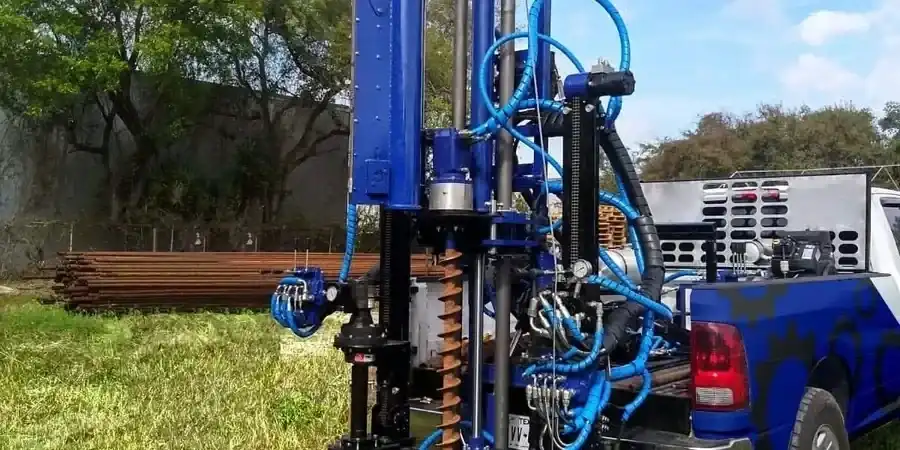
A single blow count can mislead: Shepparton's clays often require energy corrections that field logs omit unless calibrated against a known rod length and hammer system.
Method and coverage
Regional considerations
A recent warehouse development on the eastern fringe of Shepparton highlighted a common issue: the SPT N-values in a stiff clay layer appeared uniformly high, but the subsequent triaxial tests revealed a sensitive fabric that lost strength rapidly under undrained loading. Had the foundation design relied solely on raw N-values without considering the plasticity index and overconsolidation ratio, the slab could have experienced differential settlement within its first year. This is why in Shepparton we never treat SPT data in isolation — we always cross-check it with laboratory index tests and, where needed, a plate load test to verify modulus values under real footing pressures.
Process video
Standards that apply
AS 1726-2017: Geotechnical site investigations, AS 1289.6.3.1: Standard test method for SPT, AS 4678-2002: Earth-retaining structures (reference for design based on SPT data)
Other technical services
Standard SPT boreholes to 20 m depth
Continuous soil sampling and blow count logging at 1.5 m intervals, with energy calibration and rod length corrections applied in real time. Suitable for residential slabs, small commercial buildings, and road embankments in Shepparton.
SPT with automatic hammer system
Reduces operator variability and ensures consistent energy delivery. Ideal for sites where repeatability matters, such as multi-storey developments or infrastructure projects on the Goulburn Valley floodplain.
Typical parameters
Top questions
What is the typical SPT N-value range for Shepparton's alluvial soils?
In the top 3–5 m of sandy layers along the Goulburn River corridor, N-values commonly range from 5 to 15 blows per foot. In the stiff clays found east of the city centre, values often exceed 25. These numbers are raw field values and should be corrected for rod length and hammer energy before use in bearing capacity calculations.
Can SPT alone determine the liquefaction potential in Shepparton?
Not alone. The SPT blow count is the primary input for the simplified liquefaction assessment method (Youd-Idriss 2001), but you also need fines content from sieve analysis and the peak ground acceleration from AS/NZS 1170.4. In Shepparton, the presence of silty sands in the floodplain means that a clean sand N-value can overestimate resistance if the fines correction is omitted.
How much does an SPT investigation cost in Shepparton?
For a standard borehole to 10 m with SPT at 1.5 m intervals, including mobilisation within the Shepparton area, the cost typically ranges between AU$800 and AU$1,210 per borehole. This includes field logging, sample retrieval, and a basic laboratory index test. Deeper holes or sites with restricted access may increase the rate.
Do I need both SPT and CPT on the same site?
Not necessarily, but it can be beneficial. SPT provides soil samples for visual classification and index testing, while CPT gives a continuous profile of cone resistance and friction ratio. In Shepparton's layered alluvium, using CPT as a screening tool and SPT for targeted sampling at key depths often gives the best value for money.