Shepparton sits on the Goulburn River floodplain, where the top 6 to 10 metres consist of soft to firm clay and silt layers with high moisture content. The water table sits close to the surface, often within 1.5 metres, which keeps these fine-grained soils saturated and sensitive. In such conditions, the field vane shear test (VST) is the most direct method to measure the undrained shear strength of the clay without disturbing its natural fabric. We deploy the VST as a standalone investigation or in combination with a geotechnical borehole program to correlate strength profiles across the site. The procedure follows AS 1726, using a four-bladed vane rotated at a controlled rate until failure occurs. This gives us the peak and remoulded strength values needed to assess bearing capacity, excavatability, and foundation stability for residential slabs, irrigation structures, and light commercial buildings in Shepparton.
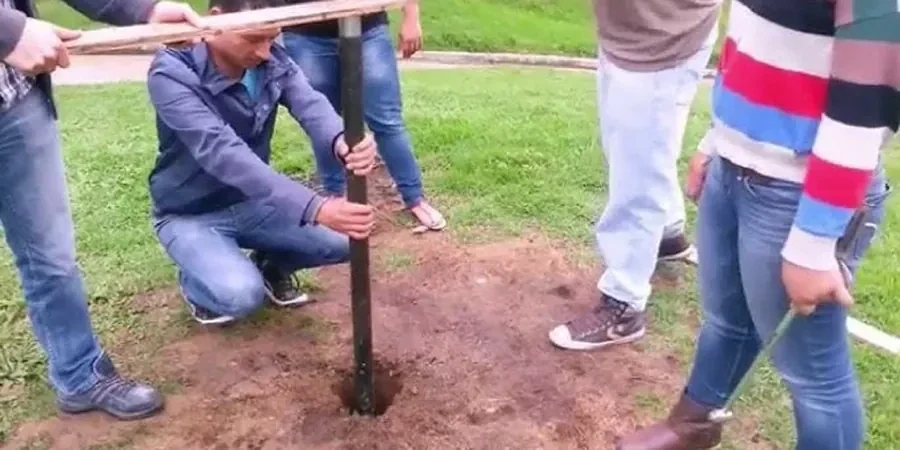
In Shepparton, the VST is the most direct way to measure undrained shear strength in saturated clays without sample disturbance.
Method and coverage
- Peak torque and corresponding undrained shear strength (su)
- Remoulded strength and sensitivity ratio
- Depth of vane insertion (typically 0.5 m increments)
- Rate of rotation per AS 1726 (6°/min for intact, 6°/min for remoulded)
Regional considerations
In Shepparton, many times we see contractors rely on pocket penetrometer readings taken from recovered split-spoon samples. That data is misleading because the sample has already been disturbed during extraction. The real risk shows up later as differential settlement under the foundation. Without a field vane shear test performed in situ at the correct depth, the design may assume a higher undrained strength than actually exists. For a site near the Goulburn River where the clay is soft to very soft, that mistake can lead to a slab cracking within the first year. We always recommend running the VST at every change of stratum, not just at standard intervals, to capture the weakest layer.
Standards that apply
AS 1726 – Geotechnical site investigations, AS 1289.6.2.1 – Standard test method for field vane shear test, BS 1377-9:1990 – In-situ vane shear test (reference method)
Other technical services
VST profiling + remoulded testing
Full depth vane shear testing at 0.5 m intervals with both peak and remoulded readings. Includes sensitivity ratio calculation and graphical profile for each borehole location.
VST for slope stability and embankments
Targeted vane testing along proposed embankment alignments or cut slopes. We provide undrained strength parameters for Bishop slip-circle analysis and factor-of-safety calculations per AS 4678.
Typical parameters
Top questions
How deep can the field vane shear test reach in Shepparton soils?
The standard rod length allows testing down to 20 metres. In Shepparton, most soft clay profiles are within the top 12 metres, so we rarely need deeper equipment. For sites with very soft clay near the surface, we can also perform the test from a lightweight tripod without a drill rig.
What is the difference between peak and remoulded shear strength from the VST?
Peak strength is the maximum torque recorded when the vane first shears the undisturbed clay. Remoulded strength is measured after rotating the vane rapidly through several revolutions, destroying the soil structure. The ratio of peak to remoulded strength is called sensitivity. In Shepparton, we typically see sensitivity values between 2 and 5, indicating moderately sensitive clay that can lose strength quickly under disturbance.
Do you combine the VST with other in-situ tests on the same site?
Yes, frequently. On Shepparton sites, we often run the VST alongside CPT or SPT boreholes to cross-calibrate results. The VST gives the most reliable undrained strength, while CPT provides continuous stratigraphy. We also use the VST together with undisturbed sampling for laboratory triaxial tests to validate the field data.
How much does a field vane shear test cost in Shepparton?
The cost for a standard VST program in Shepparton typically ranges between AU$830 and AU$2,600 depending on the number of test depths, site access conditions, and whether remoulded testing is required. For a typical residential lot with 3 to 5 test points, the lower end applies. Larger commercial sites with deeper profiling fall at the upper end. Contact us for a firm quote based on your specific scope.