A warehouse expansion on Shepparton's northern industrial strip showed cracks within six months. The cause was differential settlement between a stiff clay pad and an adjacent fill zone. This happens often here. Shepparton sits on ancient floodplain deposits from the Goulburn River. These soils vary laterally in composition and moisture. A slab can settle evenly in one sector and drop 30 millimeters in another. We measure that variation. Our team installs precise settlement markers and runs level surveys over weeks or months. The data tells us exactly where movement occurs and at what rate. Before pouring any concrete, we recommend a granulometry test to map grain size changes across the site. That step alone prevents most surprises.
A plasticity index above 35 in Shepparton clay means high shrink-swell potential, requiring deeper foundation design or Improvement.
Method and coverage
Regional considerations
Compare a house built on Shepparton's old river terrace near the CBD with one on the newer floodplain west of town. The terrace site has stiff clays with low compressibility. The floodplain site has soft alluvial clays up to 12 meters deep. Under the same 150 kPa load, the terrace settles 15 millimeters evenly. The floodplain site can show 40 millimeters of differential settlement across a 10-meter span. That difference cracks walls, jams doors, and breaks underground pipes. Missing this risk during design means expensive retrofits. Our analysis quantifies that difference before you pour a single cubic meter of concrete.
Standards that apply
AS 1726:2017 Geotechnical site investigations, AS 4678:2002 Earth retaining structures, AS 1289.7.1 One-dimensional swell/shrink, AS 1289.6.3.1 Soil consolidation test
Other technical services
Settlement Monitoring
Installation of survey pins and automated dataloggers. Weekly readings for three months minimum. Graphs show rate and magnitude of movement.
Consolidation Testing
Oedometer tests on undisturbed tube samples. We measure compression index, recompression index, and coefficient of consolidation. Results feed directly into settlement calculations.
Plate Load Tests
In-situ bearing capacity and modulus of subgrade reaction. Load increments up to twice the design pressure. Immediate and time-dependent settlement recorded.
Shrink-Swell Assessment
Atterberg limits, linear shrinkage, and free swell index. Classification of clay reactivity per AS 2870. Maps high-risk zones across your site.
Typical parameters
Top questions
How long does a differential settlement analysis take in Shepparton?
A standard analysis takes 4 to 6 weeks. This includes site visit, marker installation, two rounds of level surveys, laboratory consolidation tests, and a written report with settlement contours. Larger sites with multiple zones take 8 to 12 weeks.
What is the difference between total settlement and differential settlement?
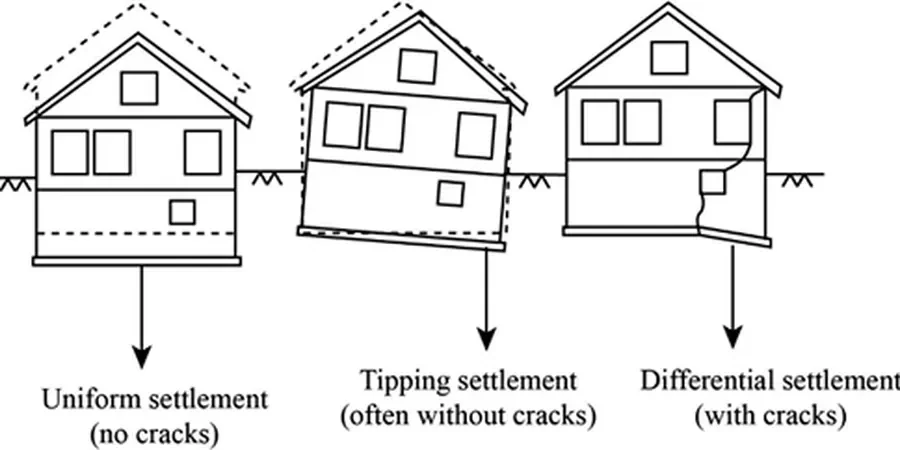
Total settlement is the overall vertical movement of a foundation. Differential settlement is the relative movement between two points on the same structure. A building can settle 50 millimeters total but crack badly if one corner moves 40 mm more than the other. Our analysis measures both and identifies the critical difference.
How much does a differential settlement analysis cost for a typical Shepparton residential site?
For a standard residential block with 3 to 5 boreholes, the cost ranges between AU$1.080 and AU$2.700. This includes field work, consolidation tests, monitoring, and a full report. Larger commercial sites with deep settlement markers and longer monitoring run higher.