A recent commercial development on Numurkah Road required a raft foundation for a 3-storey building over clayey silt. The soil profile here often presents low bearing capacity near surface, so a mat foundation distributes loads across a wide footprint. Before we recommend slab thickness or reinforcement, we run plate load tests at multiple locations to confirm modulus of subgrade reaction. Combined with shallow boreholes and laboratory consolidation tests, the data lets us design a raft that minimises differential settlement. Shepparton's floodplain geology demands this careful approach.
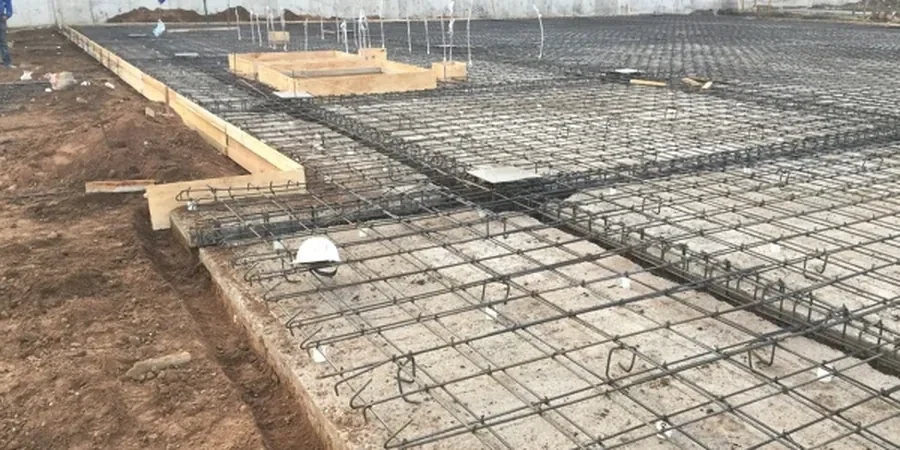
Variable alluvial soils in Shepparton mean a single raft thickness rarely works — grid testing and FEM modelling prevent differential settlement failures.
Method and coverage
- Allowable bearing capacity (typically 50–120 kPa for clays)
- Modulus of subgrade reaction (k-value) from plate load results
- Estimated total and differential settlement under working loads
- Uplift resistance if groundwater rises after heavy rain
Regional considerations
Shepparton sits on Quaternary alluvium deposited by the Goulburn River system. These soils are predominantly silty clays with intermittent sand lenses and high plasticity — liquid limits often exceed 50%. The water table fluctuates between 1.5 and 3.0 m depth depending on season and flood events. If a raft foundation is designed without accounting for these conditions, two risks emerge: first, swelling clays can lift the slab edge (especially after wet winters); second, soft saturated layers can cause punching shear failure under concentrated loads. Proper site investigation and raft design mitigate both.
Standards that apply
AS 1726-2017 Geotechnical Site Investigations, AS 2870-2011 Residential Slabs and Footings, AS 3600-2018 Concrete Structures
Other technical services
Site Investigation & Soil Logging
Boreholes to 6–10 m depth with SPT, undisturbed tube sampling, and groundwater monitoring. Soil classification per AS 1726.
Plate Load Testing
In-situ modulus of subgrade reaction (k-value) using 300–600 mm diameter plates at proposed raft level.
Settlement & Bearing Capacity Analysis
Short-term and long-term settlement estimates using consolidation parameters. Bearing capacity per Terzaghi and Vesic.
Raft Design Recommendations
Thickness, reinforcement layout, and construction joint details based on FEM modelling and AS 2870 requirements.
Typical parameters
Top questions
When is a raft foundation better than strip footings in Shepparton?
Raft foundations are preferred when the soil has low bearing capacity (under 100 kPa) or when variable layers risk differential settlement. In Shepparton's floodplain clays, a raft spreads the load evenly and resists swelling or shrinking movements better than individual footings.
What is the typical cost range for a raft foundation design study in Shepparton?
The cost for a full geotechnical investigation and raft design report typically ranges between AU$1,710 and AU$6,790, depending on the number of boreholes, laboratory tests required, and site access conditions.
How deep do boreholes need to be for raft foundation design?
Boreholes should extend at least 1.5 times the raft width below the base, or until refusal or competent stratum is reached. For a typical 4 m wide raft, we drill to 6–8 m depth to capture soft layers beneath the influence zone.